Three words, a trilogy, a dance where movements intertwine in a demanding, disarming and… deeply liberating dance. Kihon, Kata, Kumite… What notions lie behind these different pillars? Learn more about the essence of Karate in our new blog article.

The Kihon
You have to learn to walk before you can run! Kihon is the foundation of Karate. You repeat tirelessly “in a vacuum” (or on a target) the basic techniques (attacks, blocks, moves, stances, dodges, throws…) taught by your Sensei until your movements reach perfection.
During Kihon sessions, basic movements are slowly broken down to help you assimilate them more effectively. Initially simple and isolated, these are transformed into more fluid, rapid and complex sequences as you progress (kata).
Some examples of techniques:
- Dachi: basic karate stances, such as the front fighting stance (Zenkutsu Dachi)
- Uke: blocking techniques to parry an attack
- Tsuki/Zuki: fists and hands
- Geri/Keri: the kicks
- Unsoku: movements (e.g. forward or backward)
Primarily designed for beginners, this process also encourages the more experienced to concentrate more on body control and sensations. You never forget where you come from…
Kihon develops posture, coordination, balance, precision and power. It prepares you for the study of kata and kumite.
The Kata
Kata is a bit like a silent play. The lead actor choreographs a simulated combat using a series of codified techniques. He enters the scene and applies his “bunkai”, i.e. movements previously learned in the form of exercises. The aim: to improve your technique!
The sequence of each kata offers a beautiful variation in rhythm, alternating between strong moments, ample, short, fast movements and gestures that are both supple and slow. It’s a living art, in perpetual motion! It forges the body and mind by :
- Working out
- Focusing on breathing
- Emphasizing self-control through multiple movements and positions
- Exercising memory and concentration
In short, these actions must become second nature: your body speaks for itself and then reveals its full power.
At the time, these were used as a mnemonic to transmit martial knowledge. Each kata has its own meaning and symbolism. There are 26 in Shotokan Karate, 38 in Shito Ryu and 15 in Wado Ryu. For example, Empi (Flight of the Swallow in Shotokan kata) is performed at a fast tempo and is based mainly on pivots, with numerous changes of position up and down (bird-like).
There are also kata competitions.
Drawn together in a breathtaking waltz, kihon and kata feed kumite… which in turn feeds kihon and kata. They form a whole, like Yin and Yang!
Kumite
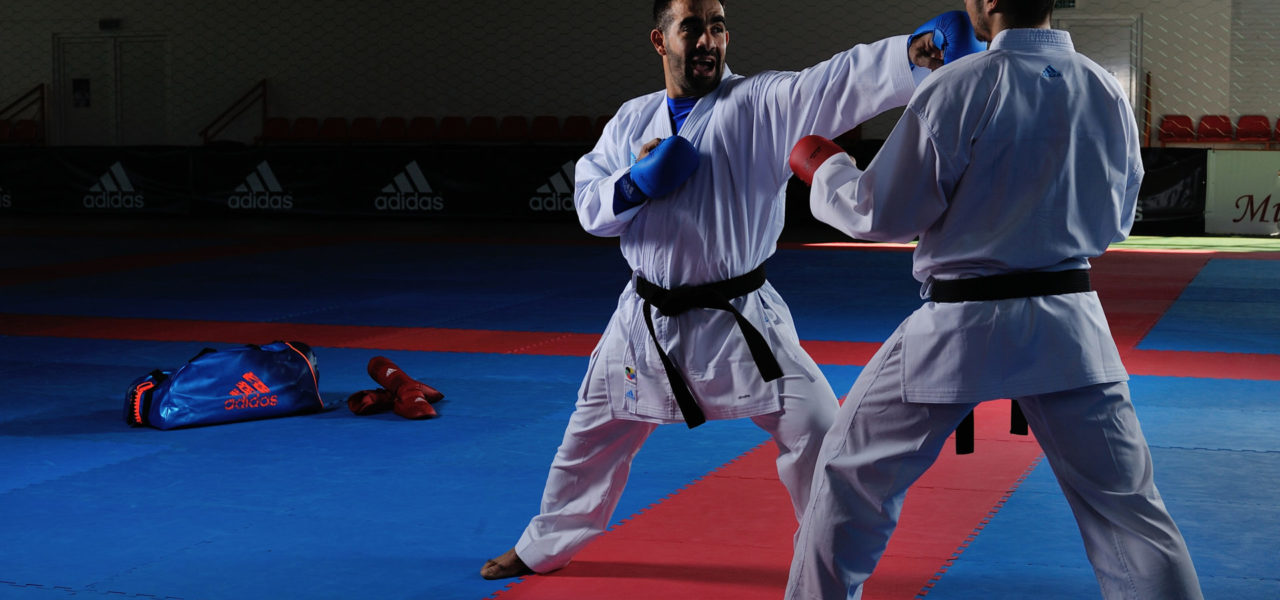
Kumite is the art of meeting. The term literally means “joining hands”, and reflects the application of basic techniques (kihon) and sequences (kata) in conjunction with a partner (karate-do philosophy) or in combat with an opponent (shiai, competitive kumite). After all, let’s not forget that the term “martial art” comes from martialis, symbolizing Mars, the god of war!
In reality, there are several types of kumite, governed by different approaches.
For example, kihon ippon kumite is based on a single attack with a single step + riposte, while gohon kumite takes place over 3 or 5 steps. The jiyu ippon kumite is also practiced and focuses on a single decisive attack starting from a 3-meter assault. But the best-known is shiai, i.e.
Movements, intelligent blocks, feints, distance management… As a fighter, you’ll acquire a range of skills to find THE weakness in your opponent.
Whether you have a competitive spirit, are looking for meaning or want to improve your physical health, the 3 Ks of karate intertwine like facets of the same diamond. Kihon structures, Kata elevates and Kumite confronts!
Need the best quality/price ratio equipment for your karate practice? Browse our online store.